
Knowledge hub

Rationale
Scientific knowledge published in languages other than English can be difficult to discover and is therefore easily overlooked in international research and evidence synthesis. This is particularly relevant to insect science, where research is closely tied to regional agricultural practices, locally important species and industries, and practitioner communities. The joint Insect-IMP WG7/WG8 workshop in İzmir, Türkiye, in April 2026 therefore explored what research on insect genetics and selective breeding exists across languages, how visible this literature is through commonly used search systems, and how it could be better connected to the wider scientific community.
During the workshop, participants worked in language groups to identify relevant databases, develop native-language search terms, explore the literature for selected insect species, and discuss how research across languages could be compared and communicated. The exercise currently covers 15 languages (Croatian, Czech, English, French, German, Greek, Hungarian, Italian, Portuguese, Romanian, Russian, Slovenian, Spanish, Turkish and Ukrainian) and focuses on four species: Bombyx mori (silkworm), Dactylopius coccus (cochineal insect), Hermetia illucens (black soldier fly) and Tenebrio molitor (yellow mealworm). These species were chosen to represent both traditionally farmed insects, for which more knowledge is likely to exist in non-English literature, and “novel” insects farmed for food and feed.
Methodology
Preliminary survey
A preliminary Google Scholar survey of five insect species identified ~111,000 hits using the English-language interface and ~34,000 hits across 11 other language interfaces over the past decade (Table 1). Because bilingual abstracts are likely to inflate the English counts, these figures are only indicative, but they suggested a substantial body of non-English literature and motivated further exploration during the workshop.
Table 1: Preliminary Google Scholar survey – hits per species and language interface (past decade)
| Language | Hermetia illucens | Tenebrio molitor | Acheta domesticus | Bombyx mori | Apis mellifera | Total |
|---|---|---|---|---|---|---|
| Chinese | 396 | 516 | 39 | 2,110 | 1,240 | 4,301 |
| Dutch | 55 | 40 | 24 | 17 | 254 | 390 |
| French | 170 | 305 | 123 | 435 | 1,840 | 2,873 |
| German | 116 | 383 | 151 | 318 | 1,050 | 2,018 |
| Italian | 271 | 222 | 86 | 215 | 594 | 1,388 |
| Japanese | 46 | 57 | 30 | 483 | 238 | 854 |
| Korean | 101 | 380 | 19 | 233 | 431 | 1,164 |
| Polish | 42 | 102 | 50 | 111 | 346 | 651 |
| Portuguese | 415 | 1,210 | 172 | 952 | 6,190 | 8,939 |
| Spanish | 771 | 1,220 | 519 | 893 | 6,670 | 10,073 |
| Turkish | 76 | 185 | 56 | 250 | 1,230 | 1,797 |
| Total (11 languages) | 2,459 | 4,620 | 1,269 | 6,017 | 20,083 | 34,448 |
| English | 15,600 | 16,700 | 8,530 | 32,400 | 37,900 | 111,130 |
| No language filter | 16,200 | 17,300 | 10,500 | 31,300 | 42,200 | 117,500 |
Keywords and search
We then quantified the amount of non-English literature with a unified Google Scholar search. The search combined standardised keywords for six core concepts relevant to insect breeding and genetics – breeding, genotyping, mating, phenotyping, reproduction and selection – with the scientific name of each focal species. The keywords were agreed in advance and translated into the participants’ native languages (Table 2), providing a multilingual search vocabulary for genetics and selective-breeding concepts, together with local species names. These are intended as literature-search terms rather than definitive translations, and we welcome corrections, alternatives, and additional terms or languages.
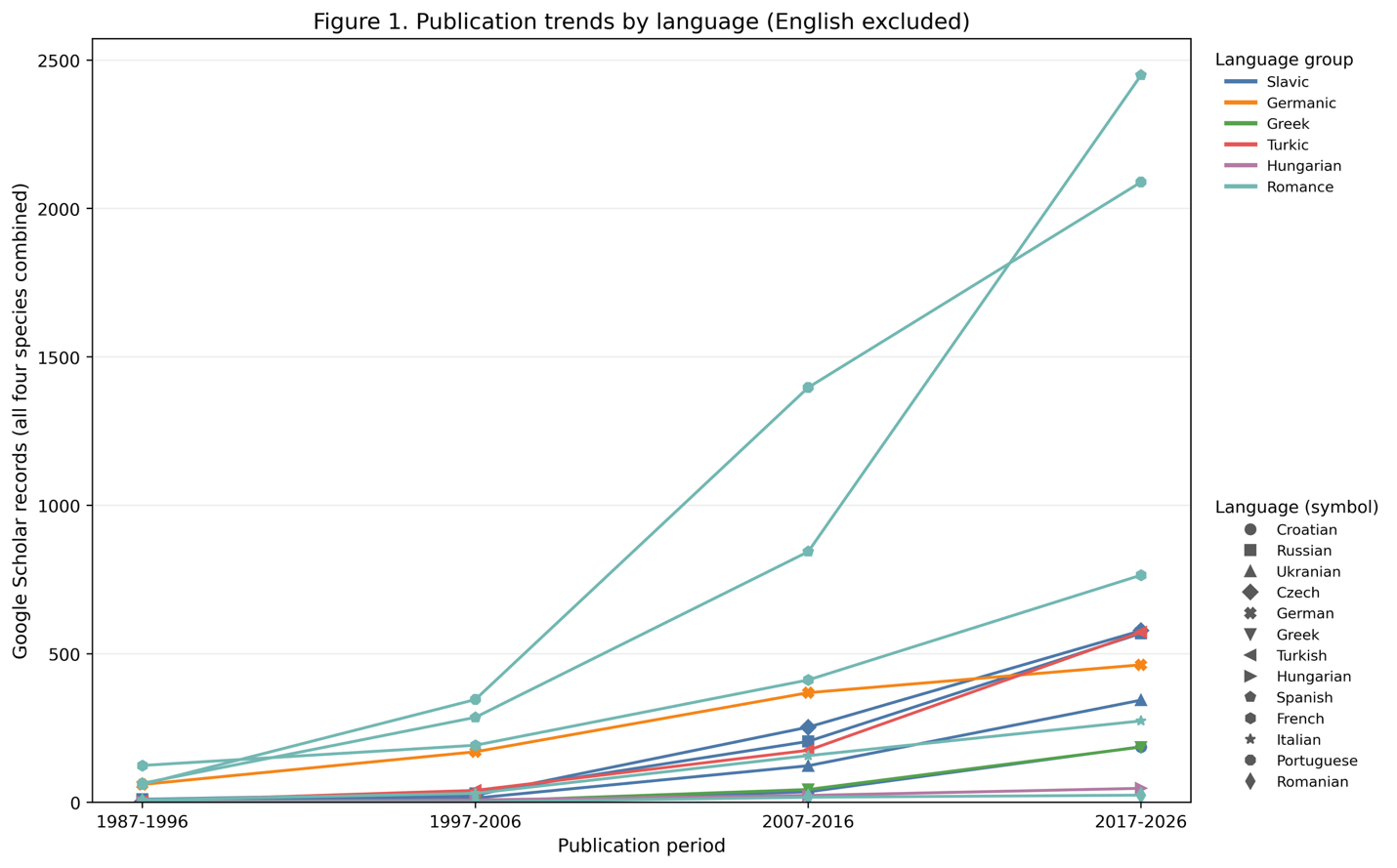
Participants also identified national and regional databases that hold non-English literature, particularly theses (Table 3). Searches were run for each focal species and language across four ten-year periods (1987–2026), revealing literature trends over the last 40 years (Table 4).
Table 2a: Search terms for the six core concepts
| Language | Breeding | Selection | Mating | Reproduction | Phenotyping | Genotyping |
|---|---|---|---|---|---|---|
| English | breeding | selection | mating | reproduction | phenotyping | genotyping |
| Croatian | uzgoj | selekcija | parenje | razmnožavanje / reprodukcija | fenotipizacija | genotipizacija |
| Czech | šlechtění / chov | selekce | páření | rozmnožování / reprodukce | fenotypizace | genotypizace |
| French | élevage | sélection | accouplement | reproduction | phénotypage | génotypage |
| German | Zucht / Züchtung / Zuchtwahl | Selektion | Paarung | Reproduktion | Phänotypisierung | Genotypisierung |
| Greek | γενετική βελτίωση | επιλογή | σύζευξη | αναπαραγωγή | φαινοτύπηση | γονοτύπηση |
| Hungarian | tenyésztés | szelekció | párosodás | szaporodás | fenotipizálás | genotipizálás |
| Italian | allevamento | selezione | accoppiamento | riproduzione | fenotipizzazione | genotipizzazione |
| Portuguese | melhoramento | seleção | acasalamento | reprodução | fenotipagem | genotipagem |
| Romanian | ameliorare | selecție | împerechere | reproducere | fenotipare | genotipare |
| Russian | разведение | селекция | спаривание | размножение | фенотипирование | генотипирование |
| Serbian | – | – | парење (parenje) | – | – | – |
| Slovenian | vzreja | selekcija | parjenje | razmnoževanje / reprodukcija | fenotipizacija | – |
| Spanish | cría | selección | apareamiento | reproducción | fenotipado | genotipado |
| Turkish | ıslah / yetiştirme / besleme / üretim | seçilim | çiftleşme | üreme | fenotipleme | genotipleme |
| Ukrainian | розведення | селекція | спарювання | розмноження | фенотипування | генотипування |
Table 2b: Local names of the focal species
| Language | Hermetia illucens | Tenebrio molitor | Dactylopius coccus | Bombyx mori |
|---|---|---|---|---|
| English | black soldier fly | yellow mealworm | cochineal | silkworm |
| Catalan | mosca soldat negra | – | – | – |
| Croatian | (crna) vojnička muha | (veliki) brašnar | košenilska uš | dudov svilac |
| Czech | bráněnka černá / bráněnka / moucha bráněnka | potemník moučný | červec nopálový | bourec morušový |
| French | mouche soldat noire | – | cochenille | – |
| Greek | μύγα μαύρος στρατιώτης | κίτρινος αλευροσκώληκας | κοχενίλλη | μεταξοσκώληκας |
| Italian | mosca soldato nera | – | – | – |
| Portuguese | mosca-soldado-negra | tenébrio / tenébrio comum / bicho-da-farinha / tenebrião | cochonilha-do-carmim / grana fina | bicho-da-seda |
| Romanian | musca soldat neagră | gândacul de făină | coșenilă | viermele de mătase |
| Russian | чёрная львинка | большой мучной хрущак / мучной хрущак | мексиканская кошениль / кошениль | тутовый шелкопряд |
| Serbian | црна војничка мува (crna vojnička muva) | брашнасти црв (brašnasti crv) | – | свилена буба (svilena buba) / свилени мољац (svileni moljac) |
| Slovenian | črna bojevniška muha | (rumeni) mokar | košeniljka | sviloprejka |
| Spanish | mosca soldado negra | – | grana cochinilla / cochinilla | – |
| Turkish | kara asker sineği / siyah asker sineği | un kurdu | koşnil / koşinil | ipek böceği |
| Ukrainian | львинка чорна | хрущак борошняний | червець | шовкопряд шовковичний |
Table 3: National and regional databases
| Language | Database | Content |
|---|---|---|
| Greek | National Archive of PhD Theses (NAPhD) | National archive of doctoral theses |
| Greek | Aristotle University of Thessaloniki (AUTh) Library | University library and repository |
| Greek | Democritus University of Thrace (DUTH) Repository | University repository |
| French | HAL open archive | French academic and grey literature, including INRAE and CEA papers |
| Portuguese | RCAAP portal | Open-access content aggregated from Portuguese institutional repositories |
| Portuguese | RCCPLP portal | Open-access content aggregated from Portuguese-speaking countries |
| Portuguese | ProQuest Dissertations & Theses Global | International theses database (subscription) |
| Serbian | DoiSerbia | Serbian scientific journals |
| Serbian | DoiSerbia PhD | Serbian doctoral theses |
| Slovenian | University of Ljubljana Repository (RUL) | University theses and publications |
| Slovenian | University of Maribor Digital Library (DKUM) | University theses and publications |
| Slovenian | University of Primorska Repository | University theses and publications |
| Turkish | Ulusal Tez Merkezi | National thesis archive |
| Turkish | TÜBİTAK ULAKBİM TR Dizin | Index of national journals |
Table 4: Google Scholar records per species and language, 1987–2026
| Language | Bombyx mori | Dactylopius coccus | Hermetia illucens | Tenebrio molitor | Total |
|---|---|---|---|---|---|
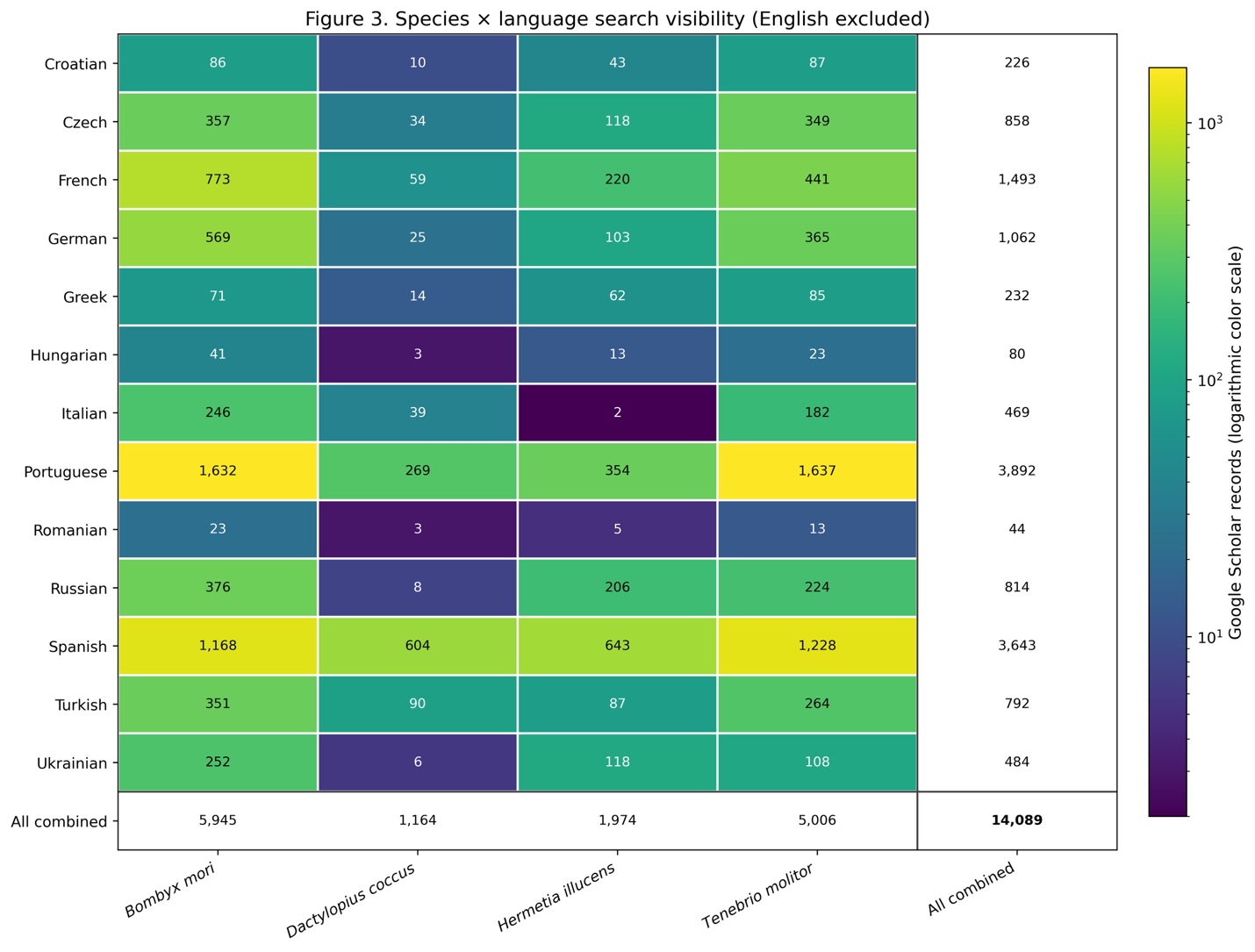
| Croatian | 86 | 10 | 43 | 87 | 226 |
| Czech | 357 | 34 | 118 | 349 | 858 |
| French | 773 | 59 | 220 | 441 | 1,493 |
| German | 569 | 25 | 103 | 365 | 1,062 |
| Greek | 71 | 14 | 62 | 85 | 232 |
| Hungarian | 41 | 3 | 13 | 23 | 80 |
| Italian | 246 | 39 | 2 | 182 | 469 |
| Portuguese | 1,632 | 269 | 354 | 1,637 | 3,892 |
| Romanian | 23 | 3 | 5 | 13 | 44 |
| Russian | 376 | 8 | 206 | 224 | 814 |
| Spanish | 1,168 | 604 | 643 | 1,228 | 3,643 |
| Turkish | 351 | 90 | 87 | 264 | 792 |
| Ukrainian | 252 | 6 | 118 | 108 | 484 |
| Non-English total | 5,945 | 1,164 | 1,974 | 5,006 | 14,089 |
| English | 50,130 | 2,174 | 16,139 | 29,330 | 97,773 |
Results
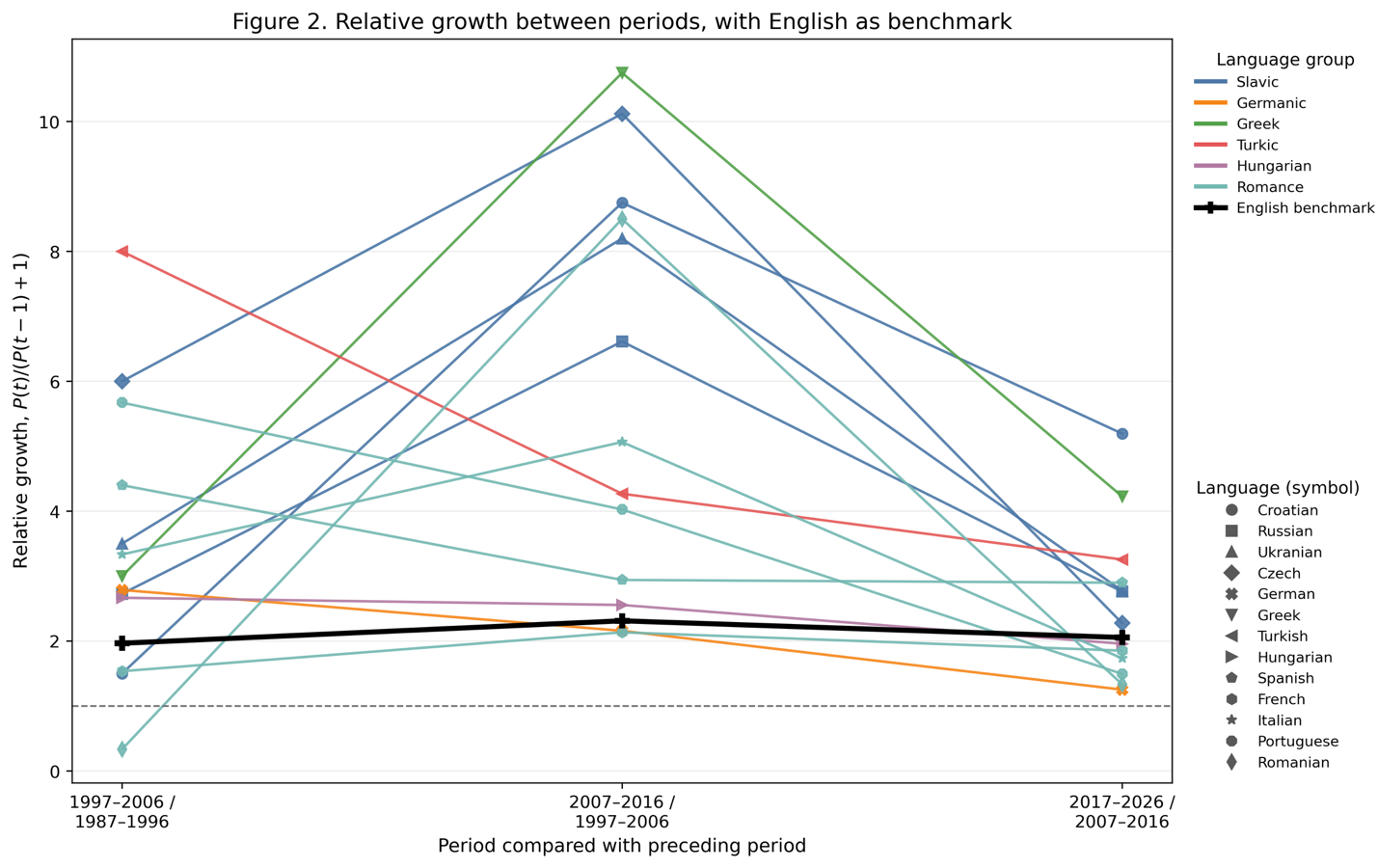
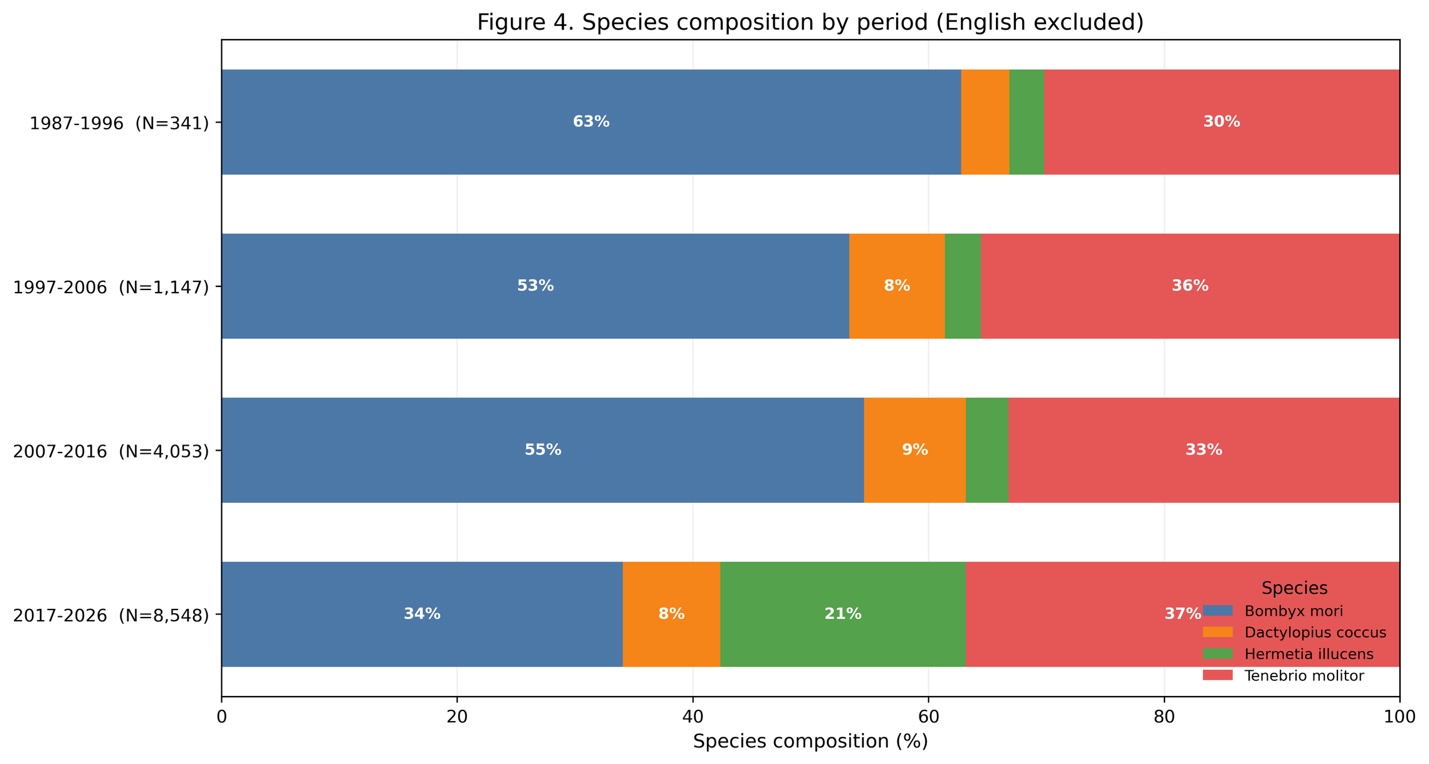
The current work is exploratory and provides a snapshot of the field rather than an exhaustive bibliographic review. Nevertheless, several patterns point to directions for further investigation. First, non-English insect research appears to have expanded substantially in recent decades (Figure 1). Second, non-English insect research has almost always grown faster than the English-language literature (Figure 2). Third, species are not equally represented across languages (Figure 3). Finally, research attention to individual insect species has shifted over time (Figure 4).
Publication hub
Participants also collected individual publications encountered in the non-English literature. Some were drawn from the Google Scholar search above, while others were found through detective work in national databases, plain Google searches and other sources. Where titles, keywords or abstracts were available only in the original language, machine-translated English versions were added to make them easier to find and compare. The collection currently holds 229 records in 14 languages, ranging from nineteenth-century sericulture literature to papers published in 2026 (Table 5). Together, these resources form the core of the Insect-IMP Cross-Language Knowledge Hub.
Table 5: Cross-language literature collection – records by language
| Language of publication | Records |
|---|---|
| Turkish | 72 |
| Italian | 45 |
| Greek | 27 |
| Spanish | 27 |
| Portuguese | 20 |
| German | 10 |
| English | 6 |
| French | 6 |
| Russian | 6 |
| Romanian | 5 |
| Slovenian | 2 |
| Czech | 1 |
| Serbian | 1 |
| Uzbek | 1 |
| Total | 229 |
Observations from the language groups
National databases may reveal literature and patterns that are poorly represented in Google Scholar. The language-group screening showed that non-English insect science is not simply a smaller version of the English-language literature: its composition varies considerably among languages, countries, species, publication types and research traditions. In several language groups, potentially useful research was concentrated in MSc and PhD theses, whose full findings rarely make it into subsequent publications. Across several languages, theses therefore emerged as an especially important, but underused and hard-to-reach, source of data.
Strong historical patterns were also apparent. Greek, Slavic, Romanian and Portuguese-language searches highlighted a substantial legacy of research on Bombyx mori, reflecting established traditions of sericulture and selective breeding. Some Slavic sources on silkworm breeding date back to the nineteenth century, while Portuguese searches recovered older work on silkworm lines, races and genetics, including publications from the former Boletim de Sericultura. In contrast, recent literature increasingly features Hermetia illucens and Tenebrio molitor, particularly in connection with food, feed, nutrition, rearing and other emerging applications, pointing to shifting priorities. There were also striking geographical and linguistic differences among species. Spanish-language literature was particularly important for Dactylopius coccus, an insect with a long history of cultivation in Latin America, although comparatively little of the material identified concerned genetics.
The screening also highlighted how scientific knowledge circulates between languages. Turkish-language searches, for example, returned many review articles, suggesting that native-language publications may play a role in synthesising internationally available knowledge for local audiences, while original research was often found in theses or published internationally in English. Our observations also suggest that searching across languages can recover additional publications – sometimes replications – which add depth to the available knowledge even where they overlap with, rather than complement, the existing English literature.
These patterns are exploratory observations from the language-group screening, not the results of a systematic comparison of publication types or research themes across languages. The counts should also be interpreted as search visibility rather than absolute publication numbers: records can overlap across species, and multilingual metadata can cause a publication to appear in more than one language search. This was already evident in the preliminary survey, where the Google Scholar results could not be treated as mutually exclusive sets of publications in separate languages.
We believe the Insect-IMP Cross-Language Knowledge Hub provides a foundation for a more systematic assessment of insect science across languages.